PRESS: Il Corriere della Sera by Federica Lavarini
Source: Il Corriere della Sera by Federica Lavarini, 16 August 2026
Automated machine translation:
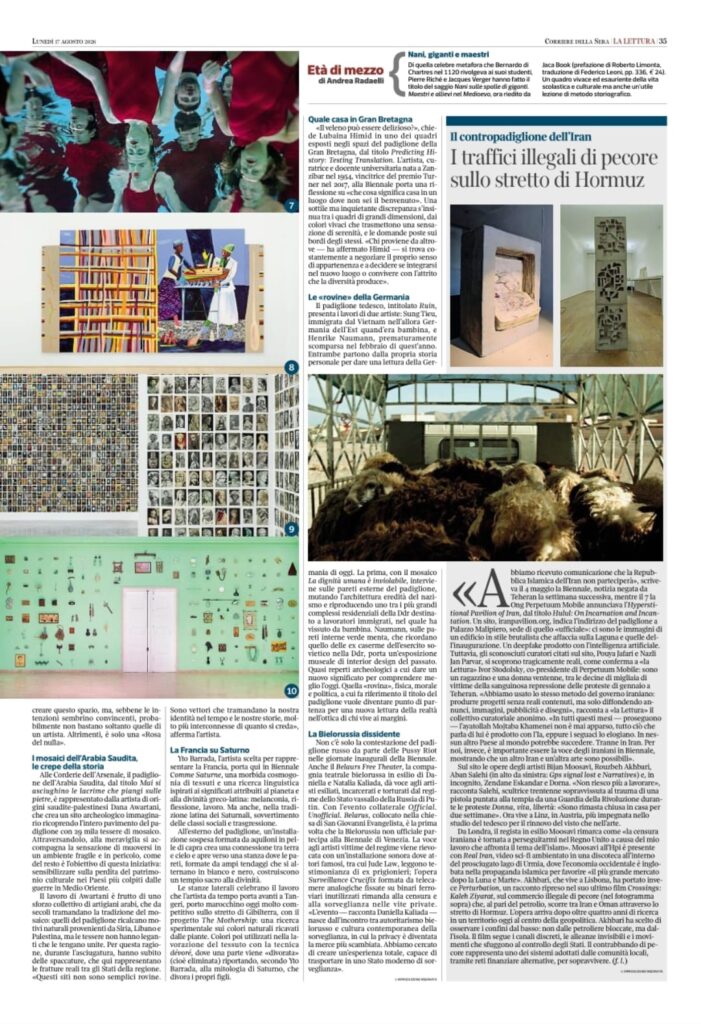
“It was announced that the Islamic Republic of Iran would not participate,” the Venice Biennale wrote on May 4, a report that Tehran denied the following week. Meanwhile, on the 7th, the NGO Perpetuum Mobilε (PM) announced the Hyperstitional Pavilion of Iran (Hpi), titled Hulul: On Incarnation and Incantation. A website, iranpavilion.org, gives the pavilion’s address as Palazzo Malipiero, the venue of the “official” pavilion: it features images of a Brutalist-style building overlooking the lagoon, as well as pictures from the opening party. It was an AI-generated deepfake.
However, the unknown curators named on the site, Pouya Jafari and Nazli Jan Parvar, turn out to have been tragically real, as Ivor Stodolsky, co-president of PM, confirms to la Lettura: they were a young boy and a woman in her twenties, among the tens of thousands of victims of the bloody crackdown on the protests in Tehran last January.
“We used the same method as the Iranian government: producing projects without any real content, simply by circulating announcements, images, advertisements, and drawings,” the anonymous curatorial collective tells us. “Over all these months,” they continue, “Ayatollah Mojtaba Khamenei has never appeared; everything that speaks of him is produced with AI, and yet his followers praise him. Nowhere else in the world could this happen. Except in Iran. Here, we grew up with the idea that the country is guided by the Twelfth Shia Imam, who has been absent since birth but will return like a Messiah: when you keep thinking about an idea, even if it does not exist, eventually you become convinced that it is real. For us, instead, through an initiative that does not benefit the regime, it is important to be the voice of Iranians in Venice at this Biennale, showing that another world and another kind of art are possible in Iran.”
The website features works by artists Bijan Moosavi, Rouzbeh Akhbari, Aban Salehi and, anonymously, Zendane Eskandar and Dorna.
“For a year now, I haven’t been able to work,” says Salehi, a thirty-year-old sculptor who survived the trauma of having a gun held to her temple by a Revolutionary Guard during the “Woman, Life, Freedom” protests. “Afterward, I stayed shut inside my house for two weeks.” She has been living in Linz for some time, more occupied with ordinary jobs and studying German to renew her visa than with art.
From London, exiled filmmaker Moosavi points out that “censorship in Iran is coming back to haunt me in the United Kingdom because of my work dealing with Islam, which means fewer opportunities and greater difficulties for my artistic practice.” For the HPI, Moosavi presents Real Iran, a sci-fi video set in a nightclub inside the dried-up Lake Urmia, where the Western economy is absorbed into Islamic propaganda in order to promote “the largest market ever to be accessed, after the Moon and Mars.”
Rouzbeh, who lives in Lisbon, instead presents Perturbation, a story featured in his latest film, Crossings: Kaleh Ziyarat, about the illegal trade in sheep which, like oil, flows between Iran and Oman through the Strait of Hormuz.
Original press text:
“È giunta comunicazione che la Repubblica Islamica dell’Iran non parteciperà” scriveva il 4 maggio scorso la Biennale di Venezia, notizia negata da Teheran la settimana successiva, mentre, il 7, la Ong Perpetuum Mobilε (PM) annunciava l’Hyperstitional Pavilion of Iran (Hpi), dal titolo Hulul: On Incarnation and Incantation. Un sito, iranpavilion.org, indica l’indirizzo del padiglione a Palazzo Malipiero, sede di quello “ufficiale”: ci sono le immagini di un edificio in stile brutalista che affaccia sulla laguna e quelle della festa di inaugurazione. Un deepfake prodotto con l’intelligenza artificiale. Tuttavia, gli sconosciuti curatori citati sul sito, Pouya Jafari e Nazli Jan Parvar, si scoprono tragicamente reali, come conferma a «la Lettura» Ivor Stodolsky, co-presidente di PM: sono un ragazzino e una donna ventenne, tra le decine di migliaia di vittime della sanguinosa repressione delle proteste del gennaio scorso a Teheran. “Abbiamo usato lo stesso metodo del governo iraniano: produrre progetti senza che ci siano reali contenuti, ma solo diffondendo annunci, immagini, pubblicità e disegni” ci racconta il collettivo curatoriale anonimo. “In tutti questi mesi, proseguono, l’Ayatollah Mojtaba Khamenei non è mai apparso, tutto ciò che parla di lui è prodotto con l’Ia, eppure i seguaci lo elogiano. In nessun altro Paese al mondo potrebbe succedere questo. Tranne in Iran. Qui siamo cresciuti con l’idea che il Paese sia guidato dal Dodicesimo Imam sciita, assente dalla nascita, ma che tornerà come un Messia: quando continui a pensare a un’idea, seppur inesistente, alla fine ti convinci che sia reale. Per noi, invece, attraverso una manifestazione di cui non si avvantaggi il regime, è importante essere la voce degli iraniani a Venezia in questa Biennale, mostrando che in Iran un altro mondo e un’altra arte sono possibili”.
Sul sito le opere degli artisti Bijan Moosavi, Rouzbeh Akhbari, Aban Salehi e, in incognito, Zendane Eskandar e Dorna. “Da un anno non riesco più a lavorare” racconta Salehi, scultrice trentenne sopravvissuta al trauma di una pistola puntata alla tempia da una Guardia della Rivoluzione durante le proteste Donna, vita, libertà: “Dopo, sono rimasta chiusa in casa per due settimane”. Da qualche tempo vive a Linz, più impegnata in lavori ordinari e nello studio del tedesco per il rinnovo del visto che non nell’arte.
Da Londra, il regista in esilio Moosavi rimarca come “la censura in Iran stia tornando a perseguitarmi nel Regno Unito a causa del mio lavoro che affronta il tema dell’Islam, il che significa meno opportunità e maggiori difficoltà per la mia attività artistica”. Moosavi all’HPIporta Real Iran, un video sci-fi ambientato in una discoteca all’interno del prosciugato lago di Urmia, dove l’economia occidentale è inglobata nella propaganda islamica per favorire “il più grande mercato a cui si sia mai avuto accesso, dopo la Luna e Marte”. Rouzbeh, che vive a Lisbona, porta invece Perturbation, un racconto ripreso nel suo ultimo film Crossings: Kaleh Ziyarat, sul commercio illegale di pecore che, al pari del petrolio, scorre tra Iran e Oman attraverso lo stretto di Hormuz.